

MITgcm helps uncover link between glacier melt and coastal productivity in Greenland.
Reporting by Helen Hill for MITgcm
A new study published in Communications Earth & Environment reveals how meltwater from Greenland’s most active glacier—Sermeq Kujalleq—triggers localized upwelling that boosts coastal productivity in West Greenland. Led by Michael Wood at Moss Landing Marine Laboratory, the study uses the ECCO-Darwin ocean biogeochemistry model, which is based on the MIT General Circulation Model (MITgcm), to simulate the complex interactions between glacial discharge, ocean mixing, and biological response.
The findings highlight a surprising consequence of ice sheet melt: the subglacial discharge from Sermeq Kujalleq appears to fuel a secondary summer phytoplankton bloom in Qeqertarsuup Tunua (Disko Bay), enhancing annual primary productivity in the region.
“Glacial meltwater isn’t just fresh—it’s buoyant and turbulent,” said Wood. “When it enters the fjord, it entrains deep, nutrient-rich water and brings it to the surface, much like upwelling systems elsewhere in the ocean.”
To quantify this effect, the team used the MITgcm-based ECCO-Darwin ocean biogeochemistry model and downscaled to 500-m grid spacing. This allowed them to simulate the vertical transport of nutrients and its impact on phytoplankton growth with unprecedented detail. The model showed that discharge-driven upwelling increases summer productivity by 15–40% in the fjord relative to a model with no discharge, though the annual carbon dioxide uptake rises by only ~3%, due to reduced solubility in warmer, plume-upwelled waters.
“The ECCO-Darwin model combines the powerful duo of ECCO ocean state estimates and the MIT Darwin ecosystem model, which allows us to mechanistically understand these intricate coupled ocean-ice-biology processes”, said co-author Dustin Carroll, the lead developer for ECCO-Darwin.
“The MITgcm was essential for capturing the fine-scale dynamics of the fjord system,” Wood said. “Its ability to resolve turbulent mixing and biogeochemical feedbacks made it possible to link physical processes to ecological outcomes.”
Sermeq Kujalleq, located near Ilulissat, is Greenland’s most prolific glacier, discharging over 40 gigatons of ice annually. During summer, meltwater from its vast drainage basin flows through subglacial channels and emerges at the grounding line, roughly 850 meters deep. As this buoyant water rises, it entrains deep fjord water, creating an upwelling flux estimated at over 45,000 cubic meters per second—nearly 40 times greater than the freshwater discharge alone.
This upwelling delivers nitrate, a limiting nutrient in Arctic waters, into the photic zone, alleviating nutrient stress and enabling a second bloom after the spring peak. The study’s simulations suggest that this mechanism could become increasingly important as ice sheet melt intensifies under future climate scenarios.
“Understanding these dynamics is critical for predicting how Arctic coastal ecosystems will adapt in the future as glacial melt will increase in response to climate change,” said Dutkiewicz, a primary architect of the Darwin ecosystem model who contributed to the biogeochemical modeling in this study. “Darwin and the MITgcm give us a powerful tool to explore these interactions across scales.”
While the enhanced productivity may benefit local food webs, the researchers caution that the long-term implications are complex. Changes in nutrient ratios, stratification, and carbon cycling could alter ecosystem structure and function in ways that are not yet fully understood.
The study underscores the importance of coupling physical and biological models to assess climate impacts in polar regions. By integrating glaciology, oceanography, and ecology, the team provides a holistic view of how Greenland’s melting glaciers are reshaping its coastal seas.
Questions/ comments email: mike.wood@sjsu.edu
Story Image: Green water alongside an iceberg that calved off Sermeq Kujalleq: Photo Credit: Aman KC, Boise State University
About the Researcher
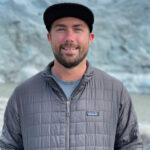 Mike Wood is an assistant professor at Moss Landing Marine Laboratory, where he leads a Computational Oceanography lab. He holds a joint appointment with the San Jose State University Department of Computer Science. He is interested in “any topic that uses satellite observations, numerical ocean models, and/or in situ measurements to further our understanding of the ocean and its role in climate change.” His main research activities are currently focused on ice-ocean-biology interactions and sea level rise from the Greenland ice
sheet. He has been an MITgcm user for six years.
This Month’s Featured Publication
-
- Michael Wood, Dustin Carroll, Ian Fenty, Clément Bertin, Basil Darby, Stephanie Dutkiewicz, Mark Hopwood, Ala Khazendar, Lorenz Meire, Hilde Oliver, Tara Parker & Josh Willis (2025), Increased melt from Greenland’s most active glacier fuels enhanced coastal productivity, Commun Earth Environ, doi: 10.1038/s43247-025-02599-1
Other New Publications last month
Cooper, Vincent (2025), Paleoclimate and Historical Perspectives on Modern Climate Sensitivity, University of Washington ProQuest Dissertations & Theses, 2025. 32115188
Delman, Andrew Spencer et al (2025), Forcing of subannual-to-decadal sea level variability and the recent rapid rise along the U.S. Gulf Coast, via ESS Open Archive, doi: 10.22541/essoar.175336987.78307881
Dong, Tianyun et al (2025), Record-breaking 2023 marine heatwaves, Science, doi: 10.1126/science.adr0910
Gonzalez, N.M., Waldman, R., Somot, S. et al (2025), Disentangling tidal and fine-scale processes at the Strait of Gibraltar and their influence on the Mediterranean region, Clim Dyn, doi: 10.1007/s00382-025-07741-5
Han, Lei (2025), Drivers of Layered Circulations in the South China Sea: Volume Flux or Vorticity Flux? arXiv: 2507.03012
Hayward, Alexander et al (2025), Antarctic phytoplankton communities restructure under shifting sea-ice regimes, Nature Climate Change, doi: 10.1038/s41558-025-02379-x
Holmberg, Daniel et al (2025), Accurate Mediterranean Sea forecasting via graph-based deep learning, arXiv: 2506.23900
Ito, Takamitsu et al (2025), Eddy-induced iron transport sustains the biological productivity in the Gulf of Alaska, ESS Open Archive, doi: 10.22541/essoar.175080521.18150857/v1
Jin, Yi et al (2025), Interannual variability of the upper- and lower-layer Indonesian throughflow based on adjoint sensitivity, ESS Open Archive, doi: 10.22541/essoar.175214828.82568209/v1
Jin, Y., Köhl, A., & Stammer, D. (2025), Attribution of interannual variability of the upper‐ and lower‐layer Indonesian throughflow based on adjoint sensitivity, Journal of Geophysical Research: Oceans, doi: 10.1029/2025JC022723
Liu, Chao et al (2025), Investigating the Temporal Sensitivity of Upper Ocean Salinity to Global Water Cycle Changes With Unsupervised Learning, Geophysical Research Letters, doi: 10.1029/2025GL115550
Li, X., & Gan, B. (2025), Modulation of Oceanic CO2 Uptake by the Kuroshio Extension Bimodal States, Geophysical Research Letters, doi: 10.1029/2025GL116195
Madiligama, M., Zou, Z. & Zhang, L. (2025), Leveraging satellite observations and machine learning for underwater sound speed estimation, Commun Eng, doi: 10.1038/s44172-025-00459-6
Makar, Pragnya et al (2025), Seasonal Variability of Internal Tides and Associated Energy Budget Over the Eastern Arabian Sea: Observations and Modeling, Journal of Geophysical Research: Oceans, doi: 10.1029/2024JC021529
Moon, JY., An, SI., Mandal, G. et al (2025), Antarctic meltwater spread pattern and its duration modulate abyssal circulation. Commun Earth Environ, doi: 10.1038/s43247-025-02589-3
Pang, C., Nikurashin, M., Peña‐Molino, B., & Sloyan, B. M. (2025), Variability due to seasonal cycle, eddies, and tides enhances water mass transformation in the Indonesian Seas, Journal of Geophysical Research: Oceans, doi: 10.1029/2024JC022265
Pimm, C., Meijers, A. J. S., Jones, D. C., and Williams, R. G. (2025), Local versus far-field control on South Pacific Subantarctic mode water variability, Ocean Sci., doi: 10.5194/os-21-1237-2025
Ren, Qiuping et al (2025), Heat Storage Pattern Linked to the Atlantic Meridional Overturning Circulation Slowdown, Geophysical Research Letters, doi: 10.1029/2025GL116801
Rodriguez, Ernesto et al (2025), Pointing Calibration for Spaceborne Doppler Scatterometers, via preprints.org, doi: 10.20944/preprints202507.0972.v1
Saçu, Şehriban et al (2025), Hydrodynamics of the Turkish Strait System: Insights from 35 years of three-dimensional numerical model simulation, Regional Studies in Marine Science, doi: 10.1016/j.rsma.2025.104315
Soares, Saolo M. et al (2025), The sea surface height spectrum of internal waves, via ESS Open Archive, doi: 10.22541/essoar.175259824.46904630
Turner, K. A. et al (2025), Modeled Centennial Ocean Warming in the Amundsen Sea Driven by Thermodynamic Atmospheric Changes, Not Winds, Geophysical Research Letters, doi: 10.1029/2024GL112287
Wang, S., Wilson, C.R., Chen, J. et al (2025), Annual polar motion and its variability, J Geod, doi: 10.1007/s00190-025-01982-2
Wang, Shengpeng et al (2025), Cross-scale Surface Kinetic Energy Transfer of Ocean Mesoscale Eddies in the Southern Ocean Revealed from the SWOT Mission, Journal of Physical Oceanography, doi: 10.1175/JPO-D-24-0134.1
Wunsch, Carl (2025), Statistical Features of A Time-Averaged Global State Estimate: Strong Regional Variations and Implications for Sea Level and Heat Content Change, Journal of Physical Oceanography, doi: 10.1175/JPO-D-25-0018.1
Zhao, Sen et al (2025), Advances of Complex Marine Environmental Influences on Underwater Vehicles, J. Mar. Sci. Eng., doi: 10.3390/jmse13071297
Zhang, Y. (2025), Basin-Width Dependence of the Meridional Width of Ocean Striations, Geophysical Research Letters, doi: 10.1029/2025GL115206
Zhang, Y.-F., Bushuk, M., Winton, M., Gregory, W., Hurlin, B., Jia, L., and Lu, F. (2025), Subseasonal Forecast Improvements from Sea Ice Concentration Data Assimilation in the Antarctic, EGUsphere, doi: 10.5194/egusphere-2025-2807
Do you have news about research using MITgcm? We are looking for contributions to these pages. If you have an interesting MITgcm project (ocean, atmosphere, sea-ice, physics, biology or otherwise) that you want to tell people about, get in touch. To make a post, contact Helen