
Recent posts
Categories
- Adjoint Modeling (6)
- Atmospheric Modeling (11)
- Biogeochemical Modeling (13)
- Climate modeling (21)
- Coupled Modeling (14)
- Lake Modeling (1)
- Model development (9)
- Model-data assimilation (19)
- Ocean modeling (87)
- Offline Modeling (9)
- Planetary Atmospheres (6)
- Sea-ice Modeling (12)
- Uncategorized (18)
 Researchers use MITgcm to explore how oceanographic connectivity shapes marine biodiversity in the Galápagos
 Ocean modeling reveals that real-world alkalinity enhancement produces far smaller chemical perturbations than commonly tested in laboratory experiments.
 Using MITgcm, researchers uncover how storm-driven mixing and ice motion combined to trigger exceptional sea ice retreat missed by operational forecasts.
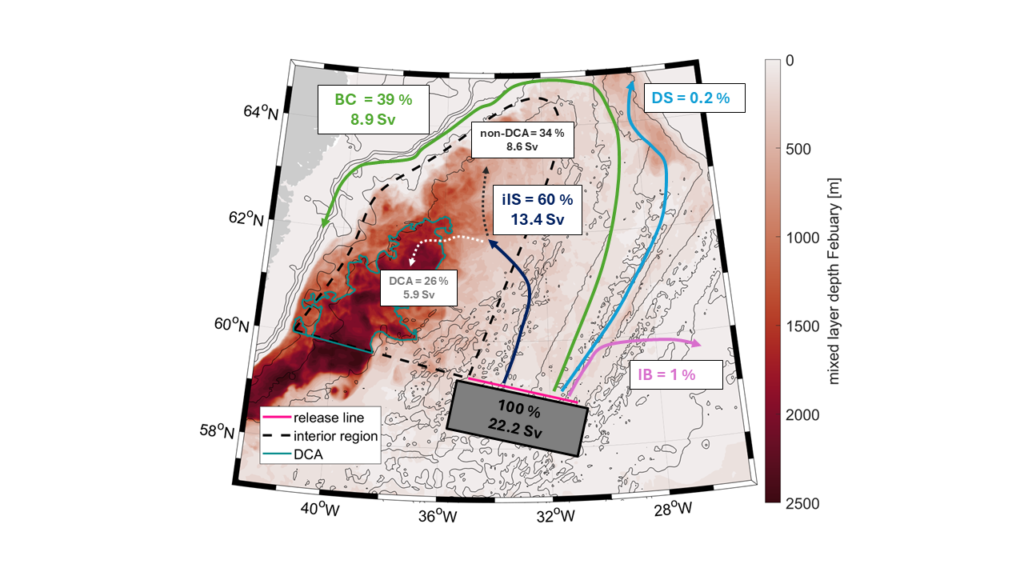 Using a high-resolution MITgcm simulation paired with Lagrangian particle tracking, a new study traces where Irminger Current waters actually go and shows they do not just hug the boundary.
 Running a coupled model to equilibrium is easy—until you include ice sheets. BIG-MITgcm tackles that head-on, using a new global-scale ice sheet model and a new coupled framework to let slow components catch up.
 Researchers at the University of Gothenburg use ECCO data to provide a new view of ocean stratification.
 Idealized MITgcm experiments reveal how monsoonal heating steers the timing of El Niño events.
 New insights using the Oceananigans.jl modeling framework.
 This month, a taste of papers using MITgcm at this year’s Ocean Sciences Meeting.
 Happy 2026: Another new year, yet another new research roundup! Best wishes as always to MITgcmers past, MITgcmers present and MITgcmers yet to come…