
Using a high-resolution MITgcm simulation paired with Lagrangian particle tracking, a new study traces where Irminger Current waters actually go and shows they do not just hug the boundary.
Reporting by Helen Hill for MITgcm
If you picture the North Atlantic as part of Earth’s climate engine, the Irminger Sea is one of the places where that engine does some of its most important work. In winter, cold winds strip heat from the ocean surface, increasing water density and driving deep convection, an essential component of the Atlantic Meridional overturning circulation. But this process is not controlled by the atmosphere alone. A study by Fried et al. (2026) shows that ocean circulation, specifically the Irminger Current, plays a central role in shaping where this convection occurs.
The Irminger Current carries relatively warm, salty water northward along the eastern edge of the basin. At first glance, it might seem like a boundary current that simply skirts the convection region, leaving the colder interior largely disconnected. However, when the authors combine a high-resolution ocean model with a Lagrangian perspective by tracking virtual water parcels through the flow, a more complex picture emerges. A substantial fraction of the current’s waters does not remain confined to the boundary. Instead, it spreads into the basin interior along intricate, looping pathways shaped by eddies and other mesoscale variability.
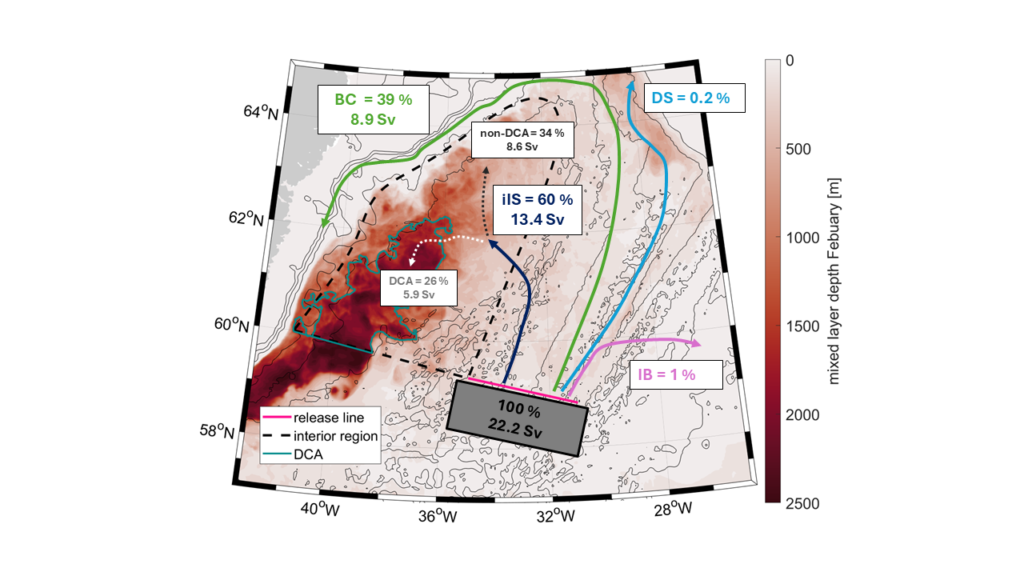
In fact, the study finds that roughly 60% of the tracked water parcels leave the boundary current and enter the interior Irminger Sea within a few months. This exchange is not driven by the mean circulation, which tends to steer water along the basin’s edges. Rather, it is the ocean’s smaller-scale variability, including eddies, meanders, and transient features, that drives this cross-basin transport. These features effectively act as conveyor belts, intermittently carrying warm, salty Irminger Current water into the central basin.
From an MITgcm perspective, the work rests on a high-resolution regional configuration that resolves these processes explicitly. The model domain covers the eastern subpolar North Atlantic, including the Irminger Sea and Iceland Basin, with horizontal grid spacing of about 2 km in the region of interest, fine enough to capture mesoscale variability, and 216 vertical levels with enhanced near-surface resolution. The simulation is forced with realistic atmospheric fields and run for one year, with 6-hourly output saved for velocity, temperature, and salinity. Those fields then drive an offline Lagrangian particle tracker, with particles seeded densely across the upper 1500 m of the Irminger Current and advected forward in time. In effect, MITgcm provides the dynamically consistent, eddy-resolving flow, while the Lagrangian framework reveals pathways and connections that are largely invisible in time-mean diagnostics.
The key question is whether any of this boundary-origin water actually reaches the deep convection area. The answer is yes: about a quarter of the released parcels make their way into the convection region within six months. This represents a strong link between the boundary current and the interior. Importantly, when these waters arrive, they remain relatively buoyant compared to the colder, denser waters in the convection region of the Irminger Sea. Although they cool and freshen along the way, they do not fully equilibrate with their surroundings.
This buoyancy has a direct dynamical consequence. Deep convection depends on surface waters becoming dense enough to sink. The steady supply of lighter water from the boundary acts to stabilize the water column, limiting how deeply convection can penetrate. In the Irminger Sea, this restratification effect is strongest in the eastern basin, effectively confining the most vigorous convection to the west.
The study also highlights differences within the Irminger Current itself. The current has a two-core structure, and waters originating in the western core are more likely to enter the basin interior and reach the convection region. By the time they arrive, however, waters from both cores have similar densities, so their overall impact depends more on how much water arrives than on subtle differences in source properties.
Taken together, these results underscore the importance of lateral exchanges in setting the structure of deep convection. Similar dynamics have been identified in the Labrador Sea, where eddy-driven transport of buoyant boundary waters limits the extent of convection. In both regions, convection emerges not simply as a local response to winter cooling, but as the outcome of basin-scale interactions between circulation, eddies, and water-mass transformation.
There are also broader implications. The Irminger Current varies in both strength and properties, including during events when freshwater anomalies propagate through the North Atlantic. Because a significant portion of its waters reaches the convection region, such variability can directly influence where and how strongly convection occurs. Given the role of the Irminger Sea in the overturning circulation, and by extension in climate, understanding these pathways is an important step toward anticipating how the system may evolve in the future.
To find out more about this study, contact Nora
Story image: Schematic showing the percentages and volume transports of the particle transportation in various categories. Fried et al (2026), fig. 7 – courtesy of the researchers.
About the Researcher
 Nora Fried is a postdoctoral researcher in the Biosphere–Atmosphere Interaction group at the University of Münster, Germany. She earned her Ph.D. in Physical Oceanography in 2024 from the Royal Netherlands Institute for Sea Research and Utrecht University. Her work focuses on North Atlantic ocean circulation and climate dynamics. She has been using MITgcm since 2022.
This Month’s Featured Publication
-
- Nora Fried, Renske Gelderloos, Oliver J. Tooth, Caroline A. Katsman, and M. Femke de Jong (2026), On the fate of the Irminger Current water and its impact on the convection region in the Irminger Sea – a Lagrangian model study, Ocean Sci., doi: 10.5194/os-22-1763-2026
Other New Publications last month
Bernish, Margaret K. (2026), Linking Phytoplankton Physiology and Ecology to Global Biogeochemical Cycles: A Modeling Approach, University of Rhode Island ProQuest Dissertations & Theses, 2026. 32451259.
Chair, Adil et al (2026), Hydrodynamics and water renewal in Nador Lagoon (Morocco), Scientific African, doi: 10.1016/j.sciaf.2026.e03450
Chang, M.‐H., et al (2026), Cold pool formation over the Taiwan Bank driven by shoaling internal tides, Journal of Geophysical Research: Oceans, doi: 10.1029/2026JC024010
Chen, L., & Wang, G. (2026), Mechanisms for meridional propagation of global mesoscale ocean eddies within a PV‐based dynamic framework, Geophysical Research Letters, doi: 10.1029/2025GL119481
Crowe, Matthew N. and Edward R. Johnson (2026), Coastal-Trapped Waves and Instabilities in Background Flows, Journal of Physical Oceanography (accepted), doi: 10.1175/JPO-D-25-0141.1
Dayoub, N. (2026), Updated Determination of the Gauss–Listing Geopotential Value and a Best-Fitting Global Reference Ellipsoid, via ResearchSquare, doi: 10.21203/rs.3.rs-9759558/v1
Finucane, Garrett Dreyfus (2026), Marine Transport of Heat Towards Ice Shelves and Sea Ice, UCLA Electronic Theses and Dissertations
Fu, Chuanshuai et al (2026), Does the Beaufort Gyre Freshwater Storage Directly Respond to Changes in Bering Strait Inflow? Insights From NEMO Modeling Experiments, JGR Oceans, doi: 10.1029/2025JC023782
Gapp, C., Falco, A., Evans-Soma, T.M. et al. (2026), Atmospheric asymmetries in WASP-121 b revealed by rotational transits detected with JWST, Nat Astron, doi: 10.1038/s41550-026-02887-6
Garouniatis, Paschalis et al (2026), Oil spill hazard assessment for the Arabian Gulf, Marine Pollution Bulletin, doi: 10.1016/j.marpolbul.2026.120029
Holland, P., Jenkins, A., Bett, D., and Bevan, S. (2026), Modelling and Parameterisation of Ice-Shelf Melting in the Amundsen Sea, Antarctica, EGUsphere [preprint], doi: 10.5194/egusphere-2026-2835
Hu, Genghua et al (2026), Seasonal variability of meridional heat and salt transport in the interior of South Indian Ocean, Journal of DSea Research, doi: 10.1016/j.seares.2026.102720
Huang, Y., Bracco, A., Polzin, K., and Gula, J. (2026), Diapycnal Mixing in Submesoscale Permitting Simulations of the Deep Brazil Basin, EGUsphere [preprint], doi: 10.5194/egusphere-2026-2869
Hyogo, Shuntaro et al (2026), What maintains the deep thermocline off Totten glacier? ESS Open Archive, doi: 10.22541/essoar.15004478/v1
Inall, M. E., Fraser, N. J., Sundfjord, A., & Meredith, M. P. (2026), Glacial ice‐front calving: Internal wave generation and melting, Geophysical Research Letters, doi: 10.1029/2026GL122121
Jing, Tian et al (2026), Full-Depth Scale-Dependent Eddy Diffusivities in the Kuroshio Extension, Journal of Physical Oceanography, doi: 10.1175/JPO-D-25-0109.1
Jiang, T., Shao, W., Hu, Y. et al. (2026), Seasonal Variability of Three-Dimensional Eddies in the Arctic Region, J. Ocean Univ. China, doi: 10.1007/s11802-026-6443-0
Liang, X. et al (2026), Effects of wintertime snow depth assimilation on summertime sea ice prediction experiments utilizing a fully coupled regional Arctic model with perfect boundary conditions, Journal of Advances in Modeling Earth Systems, doi: 10.1029/2025MS005521
Liu, Kun (2026), On the stationarity and predictability of internal tides in the northern South China Sea, Journal of Physical Oceanography, doi: 10.1175/JPO-D-25-0155.1
Liu, Tianshu et al (2026), Characterisation of Topographically-Generated Internal Waves in the Arctic Ocean Northward of the Critical Latitude, via ESS Open Archive, doi: 10.22541/essoar.15004062/v1
Long, Teng et al (2026), Prediction of Arctic sea ice concentration and thickness using a cross-attention enhanced PredRNN, Ocean Engineering, doi: 10.1016/j.oceaneng.2026.126692
Ma, Kai et al (2026), Recent Changes in Global Ocean N2O Fluxes and Their Relationship to Ocean Climate Variability, Global Biogeochemical Cycles, doi: 10.1029/2025GB008942
Makar, P., Rao, A. D., Yadidya, B., and Pant, V. (2026), Internal wave–driven diurnal density stratification in the Eastern Arabian Sea, EGUsphere [preprint], doi: 10.5194/egusphere-2026-2926
Mason, Hassan (2026), Modeling Beaufort Gyre Mesoscale Eddies and Their Impacts, New York University ProQuest Dissertations & Theses, 2026, 32577692
Miller, Charles et al (2026), Preferential Sperm Whale Range Expansion into the High Arctic Via the Deep-Water Atlantic Gateway, via ResearchSquare, doi: 10.22541/essoar.15005152/v1
Navarra, Gian Giacomo et al (2026), Kernel-Based Machine Learning Approach for Large Scale Predictions of Southern Ocean Net Primary Production, Artificial Intelligence for the Earth Systems (accepted), doi: 10.1175/AIES-D-25-0078.1
Seidel, J.V., Parmentier, V., Prinoth, B. et al. (2026), Magnetic field strengths of hot giant exoplanets consistent with Solar System values, Nat Astron, doi: 10.1038/s41550-026-02870-1
Sheng, Zhong et al (2026), Influence of typhoon on upwelling dynamics over a coastal valley in the northwestern Taiwan strait, Ocean Modelling, doi: 10.1016/j.ocemod.2026.102788
Summers, Paul et al (2026), Sudden collapse of ice mélange under increasing submarine melt at tidewater glaciers, via ResearchSquare, doi: 10.21203/rs.3.rs-9859110/v1
Tan, Weijie et al (2026), Impact of Typhoon Vongfong (2014) on subdaily deformation from GNSS observations, Geodesy and Geodynamics, doi: 10.1016/j.geog.2026.05.002
Wang, Hualing et al (2026), Spatial and Temporal Characteristics of Vertical Advective Heat Flux in the Arctic Ocean, Journal of Climate, doi: 10.1175/JCLI-D-26-0036.1
Wang, Wenbo et al (2026), Nested-discrete global grids for multi-scale ocean features: construction and performance evaluation, International Journal of Digital Earth, doi: 10.1080/17538947.2026.2681364
Womack, Christopher B. et al (2026), Optimal scenario design for climate emulation, arXiv: 2606.19302
Xia, Y., Leng, H., Wang, Z., Stevens, C., Liu, C., Yan, L., Han, X., and Chen, D. (2026), Topographic control of tides in the Ross Sea: eddy-like structures, bottom-trapped waves, and energetics, EGUsphere [preprint], doi: 10.5194/egusphere-2026-2988
Xie, H., Liu, Y., Han, G. et al. (2026), Heat transport by anticyclonic submesoscale eddies from the Beaufort Shelfbreak into the Canada Basin, Geosci. Lett., doi: 10.1186/s40562-026-00494-x
Xu, R., Zhang, W., Hu, S., Jiang, F., Jiang, L., & Jin, F.‐F. (2026), Tropical Pacific variability drives quasi‐decadal sea ice fluctuations off East Greenland, Geophysical Research Letters, doi: 10.1029/2026GL122737
Yuan, L., Z. Hu, G. Liu, D. Wang, Z. Feng and M. R. A. Shehhi (2026), “Evaluating SWOT-derived Surface Quasi-geostrophic Currents with HF Radar Observations,” in IEEE Journal of Selected Topics in Applied Earth Observations and Remote Sensing, doi: 10.1109/JSTARS.2026.3700330
Yang, Luwei et al (2026), Sensitivity of M2 barotropic tide solutions to resolution and a physically based wave drag parameterization, JAMES, doi: 10.1029/2025MS005528
Yuan, Zuqing et al (2026), Local dissipation efficiency of internal tides at key topographic features in the South China Sea, via EGU Sphere, doi: 10.5194/egusphere-2026-2713
—
Do you have news about research using MITgcm? We are looking for contributions to these pages. If you have an interesting MITgcm project (ocean, atmosphere, sea-ice, physics, biology or otherwise) that you want to tell people about, get in touch. To make a post, contact Helen