
Revisiting Extreme Arctic Ice Loss with MITgcm
Using MITgcm, researchers uncover how storm-driven mixing and ice motion combined to trigger exceptional sea ice retreat missed by operational forecasts.
Eddies, Pathways, and Convection: Tracking the Irminger Current
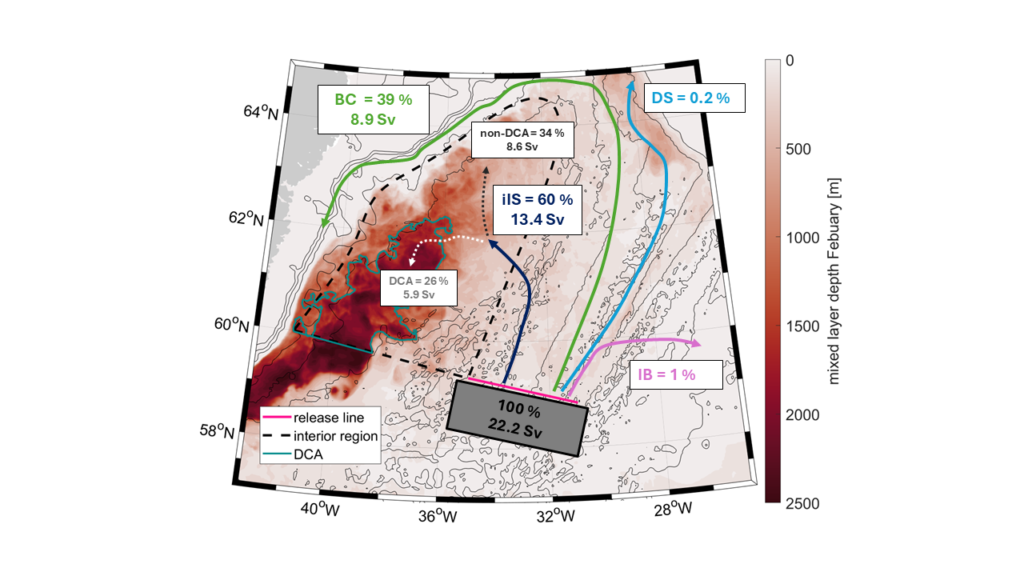 Using a high-resolution MITgcm simulation paired with Lagrangian particle tracking, a new study traces where Irminger Current waters actually go and shows they do not just hug the boundary.
Introducing: BIG-MITgcm
 Running a coupled model to equilibrium is easy—until you include ice sheets. BIG-MITgcm tackles that head-on, using a new global-scale ice sheet model and a new coupled framework to let slow components catch up.
Tracking a Sinking Signal
 Researchers at the University of Gothenburg use ECCO data to provide a new view of ocean stratification.
Why ENSO Peaks in Winter: New Clues from MITgcm
 Idealized MITgcm experiments reveal how monsoonal heating steers the timing of El Niño events.
Upper Ocean Energetics Under Sea Ice
 New insights using the Oceananigans.jl modeling framework.
MITgcm Goes to Ocean Sciences 2026
 This month, a taste of papers using MITgcm at this year’s Ocean Sciences Meeting.
2025 Research Roundup
 Happy 2026: Another new year, yet another new research roundup! Best wishes as always to MITgcmers past, MITgcmers present and MITgcmers yet to come…
Modeling Ancient Wildfires
 MITgcm sheds light on climate–vegetation–fire feedbacks in the early Triassic.
Modeling Ocean’s Most Abundant Oxygen Producer
 Researchers use MITgcm to explore the response of Prochlorococcus to changes in the marine environment.